Interactive Voice Response, or IVR, has evolved from a basic call routing tool into a powerful engine for customer experience, automation, and cost savings. The right IVR solution providers do far more than play a menu and transfer calls—they help design journeys that feel effortless for customers, reduce live agent workloads, and turn your phone channel into a strategic asset. By transforming support with contact center AI and improving call center performance with artificial intelligence, these providers enable smarter, faster, and more satisfying interactions for both agents and customers.
Choosing the right provider, however, can feel overwhelming. There are telecom carriers, cloud platforms, contact center suites, and niche specialists, all promising smart routing and AI-powered experiences. This guide walks you through what IVR solution providers actually do, which features matter most, and how to systematically evaluate vendors so you end up with a solution that delivers real, measurable value.
Modern IVR systems are increasingly dependent on emerging cloud computing technology to handle large-scale interactions and ensure seamless connectivity. Businesses also rely on high performance computing solutions to process complex data in real time, enabling AI-driven routing and intelligent call predictions. These technology-driven approaches make IVR more responsive and capable of supporting multiple channels without compromising quality.
In parallel, organizations looking to attract and retain customers benefit from effective online marketing strategies that complement automated call systems. Integrating these marketing insights helps craft IVR scripts and prompts that guide customers efficiently while reinforcing brand messaging. Similarly, proven digital marketing approaches can be aligned with IVR campaigns to create consistent experiences across email, chat, and phone interactions.
For financial services, adopting AI-enabled IVR requires understanding core finance management resources to ensure compliance and secure handling of sensitive customer data. These resources allow call centers to implement intelligent workflows that both meet regulatory standards and improve operational efficiency. By combining technology, marketing, and finance best practices, businesses can maximize the impact of their IVR systems, transforming customer support into a smarter, more strategic function.
Top 10 IVR Solution Providers for Smarter Call Centers
Choosing the right IVR solution provider can transform your contact center operations. These solutions help automate call routing, improve customer experience, and reduce agent workload. Here are the top 10 IVR solution providers, ranked based on technology, AI capabilities, and customer impact.
1. Bright Pattern – AI-Driven Contact Center Solutions
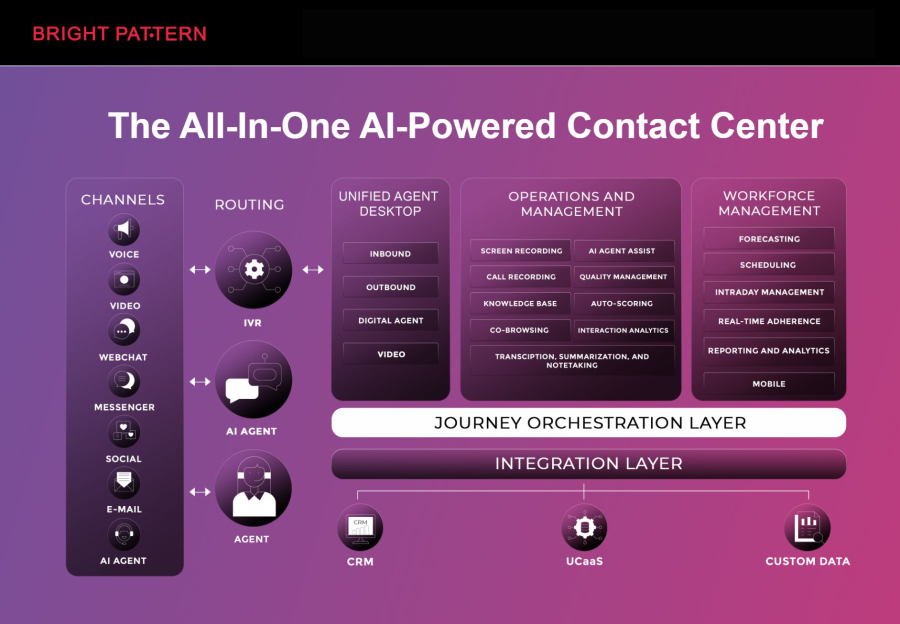
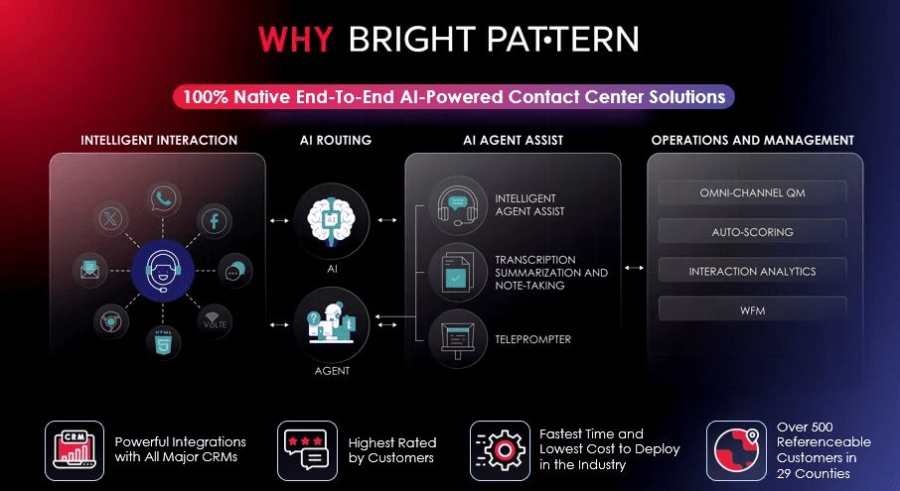
Bright Pattern leads the market in delivering advanced IVR and AI contact center solutions. Their platform integrates conversational AI, cloud contact center features, and omnichannel capabilities to provide seamless customer experiences.
Key features include:
- Conversational IVR that reduces call handling times
- AI-powered agent assist to improve first-call resolution
- Omnichannel integration for chat, email, and voice
- Real-time analytics for smarter decision-making
- Easy-to-configure workflows for rapid deployment
By choosing Bright Pattern as your IVR solution provider, businesses can enhance both customer satisfaction and operational efficiency, while leveraging AI to optimize every call interaction.
2. RingCentral Contact Center
RingCentral offers cloud-based IVR solutions with flexible call routing, CRM integration, and analytics. It is suitable for businesses of all sizes looking to streamline customer interactions.
3. Talkdesk
Talkdesk provides AI-enabled IVR that integrates with cloud contact centers, offering smart routing, workflow automation, and real-time reporting for better call management.
4. 8x8 Contact Center
8x8 delivers a cloud contact center platform with IVR, analytics, and workforce optimization. Its AI tools help automate responses and improve customer engagement.
5. Genesys Cloud CX
Genesys Cloud CX offers sophisticated IVR systems that combine AI, voice recognition, and omnichannel routing to enhance agent efficiency and customer satisfaction.
6. NICE inContact CXone
NICE inContact provides a unified contact center platform with IVR, AI routing, and performance analytics. Its AI-assisted capabilities help reduce wait times and improve resolutions.
7. Cisco Contact Center
Cisco Contact Center solutions integrate IVR with enterprise-grade networking, AI-assisted routing, and omnichannel support, making it ideal for large-scale operations.
8. Vonage Contact Center
Vonage delivers cloud-based IVR solutions that integrate with CRMs and AI analytics to improve call efficiency and customer experience.
9. Five9
Five9’s contact center platform features intelligent IVR, predictive dialing, and AI-enhanced agent support, enabling faster resolutions and improved workflow automation.
10. RingDNA (by VanillaSoft)
RingDNA offers AI-driven IVR solutions for sales and support teams, helping automate routing, capture insights, and optimize call center operations.
What Is an IVR Solution Provider?
AnIVR solution provideris a company that supplies the technology, tools, and services needed to build, host, and manage automated phone menus and call flows. Instead of building and maintaining IVR infrastructure in house, businesses rely on these providers to deliver:
- Cloud or on prem IVR platforms that answer and route calls.
- Configuration tools to design menus, prompts, and call flows.
- Integrations with CRMs, helpdesks, and back end systems.
- Analytics and reporting for call performance and customer behavior.
- Ongoing support, scaling, and system optimization.
Some IVR providers focus purely on call routing. Others bundle IVR into larger contact center platforms with features like omnichannel routing, workforce management, and AI chatbots. The best choice depends entirely on your goals, scale, and internal capabilities.
Business Benefits of Working With the Right IVR Provider
Modern IVR is not just about deflecting calls. With the right provider and well designed flows, you can create a consistent, branded experience that serves customers quickly while protecting your team from repetitive work. Key benefits include:
- Shorter wait times and faster resolution.Smart routing, priority queues, and self service options can dramatically cut the time it takes for customers to solve simple issues.
- 24 / 7 availability without 24 / 7 staffing.IVR can handle routine tasks around the clock, even when your agents are offline.
- Lower call center costs.By automating common requests and routing calls to the right team on the first try, you reduce handle time and overall call volume to live agents.
- Consistent customer experiences.Scripts, prompts, and flows are standardized, so every caller gets the same clear, compliant information.
- Higher first call resolution.With the right data and integrations, IVR can gather context before a human ever joins the call, allowing agents to resolve issues faster.
- Actionable insights.Analytics from an IVR provider show where callers drop off, which options they choose, and how flows can be optimized for better outcomes.
- Scalability during peaks.Cloud IVR platforms can scale quickly to handle seasonal spikes, marketing campaigns, or unexpected surges in call volume.
The common thread is efficiency: a good IVR solution provider frees your agents to focus on complex, high value interactions, while simple and repetitive tasks are handled automatically in a polished, customer friendly way.
Core Features to Look For in IVR Solution Providers
IVR solutions vary widely. Some offer only basic menu trees, while others provide advanced AI, natural language understanding, and deep integrations. When comparing providers, focus on the capabilities that directly support your business goals.
Call Routing and Menu Design
At the heart of any IVR solution is how it routes calls and structures menus. Look for:
- Flexible call flows.The provider should support multi level menus, conditional logic, and different paths based on customer data, time of day, or caller location.
- No code or low code designers.Visual, drag and drop interfaces help non technical teams design and iterate on flows without relying on developers.
- Queue and skills based routing.Calls should be routed to agents or teams based on skills, language, priority level, or customer segment.
- Custom greetings and branding.You should be able to configure voice prompts, messaging, and on hold content that reflect your brand tone.
DTMF and Speech Recognition
Customers interact with IVR through either keypad inputs (DTMF) or voice. Modern IVR platforms typically support both. Evaluate:
- DTMF support.Reliable recognition of touch tone input for options like "Press 1 for sales" or "Enter your account number".
- Speech recognition accuracy.If you want natural language IVR, ask about the provider's speech engines, supported languages, and real world accuracy in similar industries.
- Fallback and error handling.When the system does not understand a response, it should gracefully ask again or route to a human, not trap callers in loops.
Integrations With Your Existing Systems
The real power of IVR comes from using your business data in real time. Strong IVR solution providers offer robust integration options, such as:
- CRM and helpdesk integration.Pull caller information, past interactions, and open tickets to personalize the experience and prioritize important customers.
- Billing, order management, and ERP systems.Allow callers to check balances, order statuses, or account details without speaking to an agent.
- Directory and HR systems.Enable direct dial by name or department for internal and external callers.
- APIs and webhooks.Ensure the provider offers standard interfaces so your technical team can connect custom systems when needed.
Analytics and Reporting
Without data, it is impossible to know whether your IVR is working well. Look for providers that offer:
- Detailed call flow analytics.Reports that show entry points, branch choices, time in each step, and where callers abandon.
- Key performance indicators.Metrics like containment rate, average handle time, transfer rate, and first call resolution.
- Real time dashboards.Live views of call queues, wait times, and system health for operations teams.
- Export and data access.Options to export data or connect it to your BI tools for deeper analysis.
Security, Compliance, and Reliability
Your IVR often handles sensitive customer information and runs on critical infrastructure. High quality IVR solution providers will address:
- Data encryption.Protection for voice, signaling, and any stored data such as recordings or logs.
- Access controls.Role based access to management consoles, configuration, and analytics.
- Regulatory compliance.Support for requirements relevant to your region or industry, such as data privacy, financial regulations, or healthcare privacy standards.
- High availability.Redundant architecture, multiple data centers, and documented uptime commitments.
- Disaster recovery.Plans and capabilities to keep calls flowing during outages or unexpected events.
Types of IVR Solution Providers
Not all IVR solution providers are the same. Understanding the main categories helps you match vendor type to your strategy and resources.
| Provider Type | Typical Strengths | Best For |
| Telecom carriers | Network level IVR, phone numbers, call routing | Organizations wanting basic IVR tied closely to telephony services |
| Cloud communication platforms | APIs, flexible building blocks, scalability | Teams with development resources and custom needs |
| Contact center platforms | End to end customer service, omnichannel | Contact centers wanting integrated voice, chat, and analytics |
| Niche or vertical specialists | Prebuilt flows and compliance for specific industries | Companies in regulated or specialized sectors |
Telecom Carriers
Many traditional telecom providers offer IVR as an add on to their voice services. Benefits often include:
- Direct control over phone numbers and routing at the network level.
- Single vendor for both connectivity and IVR.
- Stable, standards based call handling.
These solutions may be more limited in terms of modern interfaces, advanced analytics, or AI features, but they can be a solid option for basic menus, small call volumes, or organizations that prioritize simplicity.
Cloud Communication Platforms
Cloud communications platforms provide APIs and developer friendly tools for building custom IVR applications. Advantages include:
- High flexibility to design unique call flows and integrations.
- Easy scaling to handle growth or fluctuating demand.
- Access to modern features such as speech recognition and programmable routing.
This route works best if you have internal or partner development resources who can design, build, and maintain your IVR on top of the platform.
Contact Center Platforms
Contact center as a service (CCaaS) providers usually include IVR as a core part of their platforms. Here, IVR is integrated with queues, agent desktops, and other channels. Benefits often include:
- Unified routing for voice, chat, and email.
- Single analytics view across channels.
- Out of the box integrations with CRMs and ticketing tools.
This type of provider fits organizations that want a comprehensive, cloud based contact center solution with IVR as one important piece of a larger ecosystem.
Niche and Vertical Specialists
Some IVR solution providers specialize in specific industries such as healthcare, finance, travel, or utilities. They typically bring:
- Prebuilt call flows that match industry norms.
- Domain expertise and relevant compliance features.
- Templates that shorten implementation time and reduce design risk.
For organizations in highly regulated or complex sectors, these providers can accelerate deployments and reduce the learning curve.
How to Evaluate IVR Vendors: A Step by Step Approach
Beyond feature lists, the best way to choose an IVR solution provider is to work through a structured evaluation process. This ensures you stay focused on business outcomes instead of being swayed by buzzwords.
Step 1: Define Clear Business Goals
Start by identifying what success looks like. Common objectives include:
- Reducing average call wait times.
- Lowering the percentage of calls that require a live agent.
- Improving first call resolution.
- Providing 24 / 7 access for basic services.
- Standardizing compliance messaging for regulated processes.
Translate these goals into target metrics. For example, aim to shift 20 percent of bill payment calls to IVR self service within six months. Clear targets make it easier to compare vendor proposals and track results after launch.
Step 2: Map Your Ideal Call Flows
Before you talk to providers, sketch the experience you want callers to have. Consider:
- Common call reasons and how they should be handled.
- Which tasks can be fully automated and which need a human touch.
- Where personalization could reduce effort, such as using caller ID to greet known customers by name.
- Escalation paths when automation fails or the caller requests an agent.
These drafts make your conversations with IVR solution providers much more productive, because you can ask them specifically how their platform would support your ideal flows.
Step 3: Compare Pricing Models and Total Cost
IVR pricing models vary. You might encounter:
- Per minute or per call charges.Based on usage volume.
- Per port or concurrent call licenses.Based on maximum simultaneous calls.
- Seat based pricing.Common with contact center suites where IVR is bundled.
- Implementation and professional services fees.For design, integration, and training.
To compare fairly, estimate your monthly call volume, peak concurrent calls, and how many interactions could shift to self service. Ask each provider to model costs based on the same assumptions, including any growth you expect over the next one to three years.
Step 4: Assess Onboarding, Support, and Ease of Use
The best technology will fail if your team struggles to use it. When evaluating IVR vendors, explore:
- How long typical implementations take for organizations like yours.
- Whether you get a dedicated onboarding specialist or project manager.
- Training options for your administrators and supervisors.
- Availability and responsiveness of support teams.
- The usability of configuration tools for non technical staff.
Ask for product demonstrations focused specifically on everyday management tasks, such as changing prompts, adding a new menu option, or updating routing during a holiday schedule.
Step 5: Run Pilots and Measure Results
Once you narrow your list, small pilots or proof of concept projects are invaluable. During a pilot, you can:
- Test real call flows with a subset of customers.
- Validate speech recognition quality and integration performance.
- Gather feedback from agents and supervisors.
- Measure initial improvements in key metrics.
Pilots reduce risk and give you confidence that the chosen IVR solution provider can deliver on their promises in your environment, with your customers.
Key Questions to Ask Potential IVR Solution Providers
Structured questions help you quickly separate marketing claims from operational reality. Consider asking:
- Which industries and customer sizes do you primarily serve, and what results have clients achieved?
- How do you handle spikes in call volume, such as during campaigns or outages?
- What level of control will our team have over modifying call flows without developer support?
- Which security and compliance certifications do you maintain, and how is data protected?
- How do you support integrations with our existing CRM, helpdesk, and internal systems?
- What is your typical implementation timeline for organizations similar to ours?
- How is pricing structured and how can we forecast total cost of ownership over several years?
- What analytics are available, and can we access raw data for our own reporting tools?
- How do you handle ongoing updates, new features, and system maintenance?
Implementation Best Practices for a High Performing IVR
Regardless of which provider you choose, a few best practices will help your IVR deployment succeed and deliver strong returns.
- Keep menus simple and intuitive.Avoid long lists of options or deeply nested menus. Prioritize the top call reasons and keep language clear and conversational.
- Design for escape to human help.Always provide an obvious way to reach an agent, especially in high stress scenarios like billing issues or service outages.
- Use data to personalize.Where appropriate, identify the caller and tailor options to their profile, recent orders, or account status.
- Test prompts with real customers.Short user tests reveal confusing wording, missing options, or friction points that internal teams might miss.
- Monitor and iterate.After launch, review analytics regularly, refine flows, and adjust prompts to improve containment and satisfaction.
- Align with agents.Ensure your frontline teams understand how the IVR works, so they can explain it to customers and help identify improvement opportunities.
Real World Success Scenarios With Strong IVR Providers
To visualize what a strong partnership with an IVR solution provider can achieve, consider a few common success scenarios.
- Utilities and service providers.By enabling automated balance inquiries, payment processing, and outage updates, these organizations often reduce live billing calls by double digit percentages while offering 24 / 7 convenience.
- Retail and e commerce.IVR that pulls real time order data lets customers check delivery status, modify orders, or request returns without waiting for an agent, improving satisfaction during peak seasons.
- Healthcare organizations.With the right provider, healthcare teams deploy IVR for appointment reminders, prescription refills, and lab results notifications, easing staff workloads and keeping phone lines open for urgent needs.
- Banks and financial institutions.Secure, compliant IVR flows allow customers to check balances, transfer funds, and report lost cards quickly, while routing high risk cases directly to specialized teams.
In each case, the combination of thoughtful design and a capable provider turns the phone channel into a proactive, high value touchpoint instead of a source of frustration.
Future Trends in IVR and Why Your Provider Choice Matters
IVR technology continues to advance, and choosing a forward looking provider positions you to take advantage of new capabilities as they emerge. Key trends include:
- Conversational IVR.Natural language understanding allows callers to speak in everyday phrases instead of following rigid menu paths, making interactions smoother and more human.
- Deeper AI assisted automation.Machine learning powered routing, sentiment analysis, and intelligent escalation can further reduce effort for both customers and agents.
- Omnichannel consistency.IVR is increasingly part of a unified experience across voice, chat, and messaging, so customers can start in one channel and continue in another without repeating themselves.
- Proactive outreach.Outbound IVR campaigns, combined with inbound flows, enable reminders, alerts, and follow ups that reduce missed appointments and support tickets.
- Stronger analytics and journey insight.More sophisticated reporting turns IVR interactions into a rich source of insight about customer needs and friction points.
Partnering with an IVR solution provider that invests in these areas ensures your system will not only meet today's needs but also evolve with customer expectations.
Bringing It All Together
An IVR system can be a customer's first impression of your brand when they pick up the phone. The right IVR solution provider helps you turn that moment into a smooth, efficient, and even delightful experience that saves time for your customers and your team.
By understanding the types of providers in the market, focusing on core features that align with your goals, and following a structured evaluation process, you can select a partner that delivers real, measurable improvements in customer satisfaction and operational efficiency. With a thoughtfully implemented IVR and a supportive provider at your side, your contact center can handle more volume, deliver faster answers, and set a higher standard for every phone interaction.
